July 4 in Ellijay has a charm most places cannot fake.
Downtown fills with families. Vendor tents open. The parade rolls through town. Fireworks light up the North Georgia sky after dark. Visitors head back to cabins, wineries, hotels, campsites, and homes along mountain roads.
It sounds simple.
Then the night shifts.
Traffic slows. Tempers rise. Cell service drops. Rides are harder to find. Someone says, “I’m fine.” Someone else says, “It’s just a short drive.”
That is where a holiday night can become a Georgia DUI case.
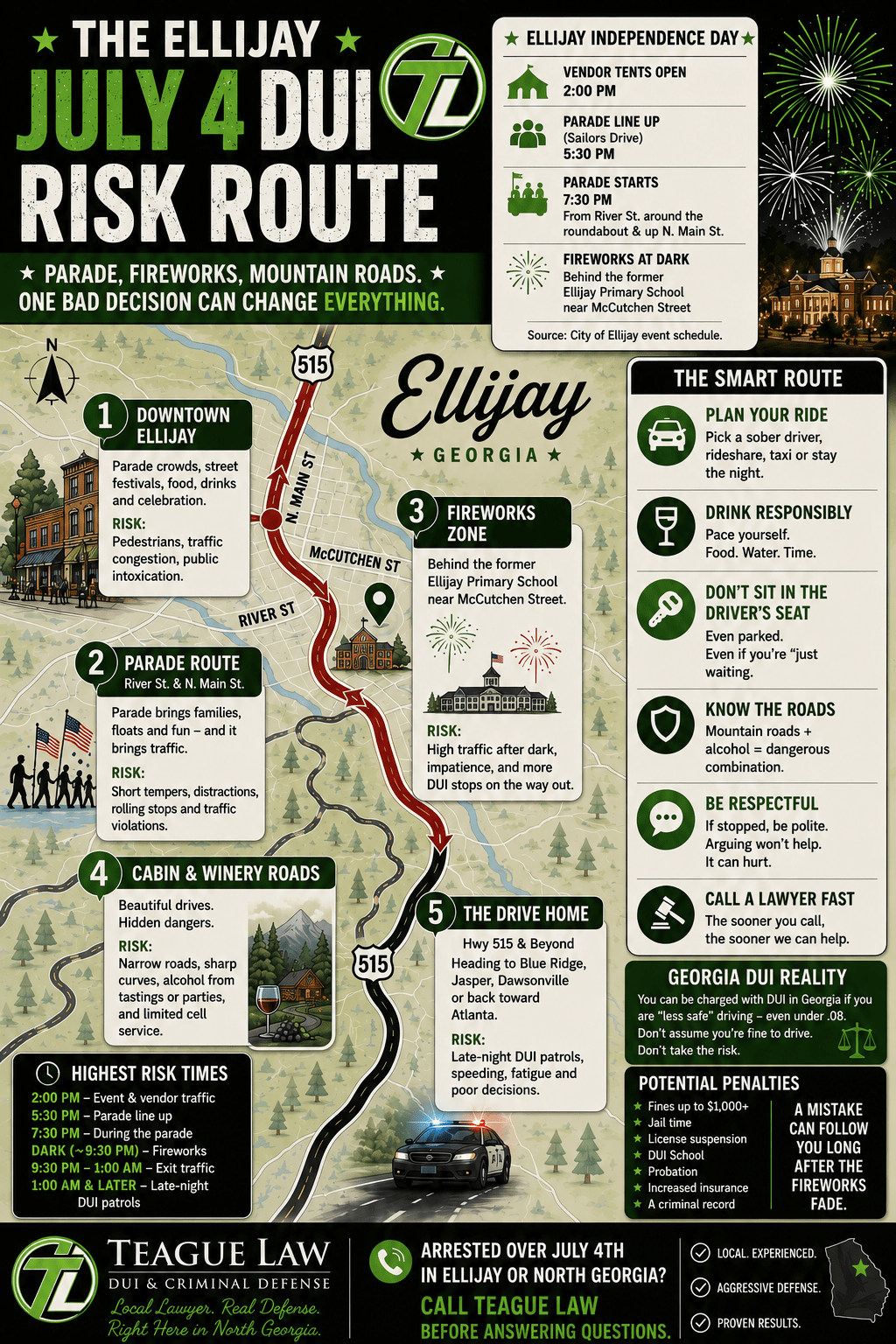
Teague Law created The Ellijay July 4 DUI Risk Route to help drivers, visitors, and families understand where DUI risk can build during Independence Day celebrations in Ellijay and North Georgia.
Why July 4 Can Be a High-Risk DUI Night in Ellijay
Ellijay is not Atlanta. It is not a massive downtown grid with endless taxis and transit options. That is exactly why July 4 can carry a different kind of DUI risk.
People may be driving from:
- Downtown Ellijay
- A cabin rental
- A winery or tasting room
- A lake house
- A family cookout
- A campground
- A fireworks viewing spot
- A restaurant or bar
- A nearby town like Blue Ridge, Jasper, Dawsonville, or Canton
Many of those routes involve dark roads, curves, hills, narrow shoulders, deer, limited lighting, and fewer easy options once someone has already been drinking.
A person may feel “okay” to drive. Police may see it differently.
Ellijay July 4 Event Areas Where DUI Risk Can Build
The City of Ellijay’s Independence Day event schedule lists vendor tents, parade lineup, parade route details, and fireworks near McCutchen Street. These areas create natural traffic pressure points.
The goal is not to scare anyone away from a hometown celebration. The goal is to help people avoid the common mistakes that lead to traffic stops, DUI investigations, and criminal charges.
Risk Zone 1: Downtown Ellijay
Downtown Ellijay is the heart of the holiday.
People gather early. Families walk between businesses. Food, drinks, vendors, and celebration all mix with street traffic. For drivers, the biggest risk is not just alcohol. It is distraction.
During a crowded holiday event, police may watch for:
- Rolling stops
- Unsafe turns
- Speeding through crowded areas
- Pedestrian issues
- Open containers
- Disorderly behavior
- Drivers who appear confused, impatient, or impaired
A driver who has been drinking may think they are blending in with traffic. In a small-town holiday crowd, one bad turn can stand out fast.
Click to contact us today
Risk Zone 2: The Parade Route
The published Ellijay parade route starts from Sailors Drive, travels along River Street, loops around the roundabout, and continues up North Main Street toward the elementary school area.
Parade routes create a special kind of driving risk.
Drivers may be dealing with blocked roads, pedestrians, chairs near the street, kids crossing unexpectedly, vehicles looking for parking, and people trying to get around the route.
That can lead to traffic stops for things that seem minor:
- Failure to maintain lane
- Illegal turns
- Obstructing traffic
- Running a stop sign
- Not yielding to pedestrians
- Driving too fast for conditions
- Frustrated driving around blocked roads
Once the stop starts, an officer may ask where the driver is coming from, whether they had anything to drink, and where they are headed.
That is when a simple traffic stop can become a DUI investigation.
Complete a Free Case Evaluation form now
Risk Zone 3: The Fireworks Exit Zone
Fireworks at dark are the emotional high point of the night.
They are also one of the biggest exit-pressure points.
After the fireworks, many people leave at once. Drivers may be tired, hot, impatient, overstimulated, or trying to beat everyone else out of town. Anyone who drank earlier may feel more sober than they really are.
The risk climbs because police may be watching for impaired drivers after the fireworks crowd starts leaving.
Common post-fireworks stop triggers can include:
- Speeding
- Wide turns
- Drifting within a lane
- Driving without headlights
- Following too closely
- Sudden braking
- Slow reactions at lights or stop signs
- Cutting through side streets
- Driving the wrong way around blocked routes
If someone has been drinking, this is not the time to “just get back to the cabin.”
Risk Zone 4: Cabin and Winery Roads
This is one of the most local DUI risk angles for Ellijay.
Visitors come to North Georgia for cabins, mountain views, orchards, wineries, restaurants, hiking, river trips, and quiet back roads. Those same roads can become risky late at night.
Mountain and rural roads can make impaired driving more dangerous because of:
- Sharp curves
- Narrow lanes
- Limited lighting
- Gravel driveways
- Wildlife
- Poor weather changes
- Limited shoulder space
- Patchy cell service
- Fewer late-night ride options
A driver who might stay inside the lane on a straight city street may drift on a curving mountain road. A person who thinks they only need to drive “a few minutes” may still face a DUI stop before they get there.
Risk Zone 5: Highway 515 and the Drive Home
Highway 515 and nearby routes are common paths for people heading toward Blue Ridge, Jasper, Dawsonville, Canton, or back toward metro Atlanta.
After fireworks, police may pay attention to drivers leaving celebration areas and heading onto larger roads.
The drive home can be one of the worst moments to make a bad call. People are tired. The night feels over. Passengers may be asleep. The driver may think the risk has passed.
It has not.
A DUI arrest can happen minutes from home.
Georgia DUI Law is Not Just About 0.08
Many drivers think DUI means one thing: a blood alcohol concentration of 0.08 or higher.
Georgia DUI law is broader than that.
A person can be charged with DUI if they are under the influence of alcohol to the extent that it is less safe for them to drive. That means the state may try to prove the person was less safe, even if the person does not have a 0.08 test result.
Georgia DUI law can also involve drugs, marijuana, controlled substances, toxic vapors, or a combination of substances.
That matters on July 4 because alcohol is not the only issue. Fatigue, heat, prescription medication, marijuana, and mixed substances can all become part of a DUI investigation.
“I Felt Fine” is Not a Defense Strategy
A driver may feel steady. They may speak clearly. They may believe they were driving carefully.
That does not stop a DUI investigation.
Police may look at the whole picture, including:
- Driving pattern
- Odor of alcohol
- Red or watery eyes
- Speech
- Balance
- Admissions about drinking
- Field sobriety test performance
- Breath or blood results
- Body camera footage
- Witness statements
- Open containers
- Drugs or medication found in the vehicle
A DUI case is built from details. Some details may help the defense. Others may hurt. That is why it is risky to guess, explain, or argue your way through a stop.
July 4 Mistakes That Can Turn Into DUI Cases
Most DUI cases do not start with someone saying, “I’m about to make a life-changing mistake.”
They start with small decisions.
Driving Home After “Just a Couple”
This is the classic holiday mistake. The driver does not feel drunk. The ride home seems short. Everyone else has been drinking more.
None of that guarantees the driver is safe or legally protected.
Taking the Back Road to Avoid Police
A back road may feel safer, but dark rural roads can make impaired driving more obvious and more dangerous. Swerving, braking late, drifting, or taking curves poorly can attract attention.
Sitting in the Driver’s Seat After Drinking
People sometimes sit in the driver’s seat to cool off, charge a phone, sleep, or wait. That can still invite police attention, especially if officers believe the car was recently driven or was about to be driven.
The smarter choice is simple: do not put yourself behind the wheel after drinking.
Waiting Too Long to Call a Lawyer
After an arrest, some people wait because they are embarrassed, scared, or hoping the case will disappear.
Waiting can cost time. Court deadlines, license issues, evidence, body camera footage, and witness memories may all matter.
The sooner a defense lawyer reviews the case, the sooner the defense can start asking the right questions.
What Police May Watch For After July 4 Events
During a holiday DUI enforcement period, a driver may be stopped for a traffic issue before DUI is ever mentioned.
Common warning signs police may watch for include:
- Speeding
- Weaving
- Failure to maintain lane
- Wide turns
- Running stop signs
- No headlights
- Braking for no clear reason
- Driving too slowly
- Following too closely
- Stopping past the line
- Illegal U-turns
- Failure to signal
- Open container concerns
One of these issues may lead to a stop. The stop may lead to questions. The questions may lead to an arrest.
What to Do If You are Stopped After July 4 in Ellijay
A DUI stop is stressful. Panic makes it worse.
If you are stopped, stay calm and respectful. Keep your hands visible. Provide your license, registration, and insurance when asked. Do not argue on the roadside. Do not make sudden movements. Do not try to charm, joke, or talk your way out of the stop.
You can be polite without giving long explanations.
You can respect the officer without giving up your rights.
If you are arrested, ask to contact a lawyer as soon as possible.
What to Do After a DUI Arrest in North Georgia
An arrest is not a conviction.
If you were arrested for DUI after July 4 in Ellijay, Gilmer County, or North Georgia, take the next steps seriously:
- Save every document police gave you
- Write down what happened while you remember it
- Do not post about the arrest online
- Do not discuss case details with friends by text
- Note where you were stopped
- Note what the officer said and asked
- Note whether there were passengers or witnesses
- Contact a DUI defense lawyer fast
The facts matter. The stop matters. The testing process matters. The officer’s report matters. The timeline matters.
A DUI defense lawyer can review whether police had a valid reason for the stop, whether the investigation was handled properly, whether testing issues exist, and what defenses may apply.
FAQ: Ellijay July 4 DUI Questions
Can I get a DUI in Georgia if I am under 0.08?
Yes. Georgia has a “less safe” DUI theory. A person may face a DUI charge if the state claims alcohol, drugs, or another substance made them less safe to drive, even without a 0.08 result.
Can prescription medication lead to a DUI charge in Georgia?
It can. If medication affects a person’s ability to drive safely, it may become part of a DUI investigation. This can be especially risky when medication is mixed with alcohol.
Is it safer to drive back roads after drinking?
No. Back roads can be darker, narrower, and harder to drive safely. Sharp curves, limited lighting, and rural conditions can make late-night impaired driving more dangerous.
Should I explain to police that I only had a couple drinks?
Be careful. Roadside statements may become evidence. Stay respectful, provide required documents, and do not try to talk your way through legal questions.
Should I call a lawyer after a first DUI arrest?
Yes. A first DUI can still bring serious consequences, including fines, jail time, license issues, probation, DUI school, increased insurance, and a criminal record. A lawyer can help you understand the case and your options.
Plan the Ride Before the First Drink
The safest July 4 DUI defense is the one you never need.
Before the parade starts, decide who is driving. Before the fireworks begin, know where your ride is coming from. Before you leave downtown, be honest about whether you should be behind the wheel.
If you drank, do not drive.
If your friend drank, do not let them drive.
If you are not sure, stay put.
A small-town holiday should stay a small-town holiday. It should not turn into a Georgia DUI case.
Arrested After July 4 in Ellijay or North Georgia?
If you were arrested for DUI after a July 4 celebration in Ellijay, Gilmer County, or North Georgia, contact Teague Law before answering questions about your case.
Teague Law defends people facing DUI and criminal charges in Ellijay and surrounding North Georgia communities.
Call Teague Law today to discuss your case with an Ellijay DUI lawyer and protect your future.
This page provides general information only and is not legal advice. Reading this page does not create an attorney-client relationship. Every case is different.
Call or text (706) 276-3636 or complete a form